
An API attack doesn’t always start with a spectacular exploit. It may start with a poorly documented endpoint, an overly permissive token, a poorly implemented object access control or an unexpected request accepted by the backend. In some cases, an SQL injection on a secondary route or poor management of OAuth scopes is enough to expose business data, user profiles or administrative functions. This is precisely why a pentest, particularly in Toulouse, must go beyond the visible website (front end). It must assess APIs, their authentication mechanisms, tokens, authorization controls and their ability to serve as an entry point to the rest of the information system. A useful cybersecurity audit therefore checks the robustness of routes, backends, JSON exchanges, server-side controls and authentication secrets. A well-conducted penetration test answers a simple question: can an exposed API turn a design error into a real compromise?
Why Toulouse organizations need to monitor their API exposure
Toulouse is built on a technology-intensive economic fabric, where digital, industrial, aerospace, healthcare, services and interconnected business platforms coexist. In these environments, APIs play a central role. They link web front-ends, mobile applications, partners, internal tools, automated processing and third-party services. The problem is that an API is not just a convenient connector. It’s also an extremely profitable technical exposure point for an attacker.
The most common API weaknesses are rarely exotic. They often stem from design or implementation errors:
- insufficient object access controls ;
- tokens that are too permissive or too long;
- undocumented but accessible routes ;
- client-side filtering instead of server-side control ;
- no rate limiting ;
- incomplete logging of sensitive calls.
In this context, a poorly mastered API architecture resembles a control tower with temporary badges. The organization thinks it knows who comes in, who goes out and who has access to what. However, if badges are misallocated, reused for too long, or insufficiently verified at each point of passage, movements become opaque, and the risk spreads very quickly.
This is why a pentest for a company in Toulouse must include APIs when they drive sensitive data, critical functions, business operations or interconnections between services.
How an API penetration test works in Toulouse
For more information on pentesting: https: //www.hackmosphere.fr/test-intrusion/
An API-oriented penetration test in Toulouse follows a progressive logic. The aim is not to provoke massive errors, but to understand what the application actually exposes, what the server accepts, and what an attacker could hijack in a credible scenario.
1. Recognition: find the routes and services that are really exposed
The first step is to map the endpoints, parameters and HTTP assets linked to the authorized perimeter.
- gau allows you to retrieve URLs and paths from a variety of mapping sources.
- httpx helps identify which web services are actually active, their responses and certain attack surface characteristics.
This phase often reveals forgotten endpoints, old API versions, secondary environments, overly visible pre-productions or technical resources not intended for long-term exposure.
2. Identifying faults: distinguishing exploitable faults from simple anomalies
Once the map has been drawn up, the pentest looks for flaws that can really have an impact.
- Arjun identifies hidden or undocumented parameters in HTTP requests.
- JWT Tool is useful for analyzing the structure, usage and certain bad practices associated with JWT tokens.
Typical checkpoints include :
- poor authorization controls ;
- OAuth scopes too wide ;
- unfiltered parameters ;
- accessible secondary roads ;
- server-side validation errors ;
- weak session or token management.
3. Controlled operation: demonstrating impact without disrupting production
The operational phase serves to confirm that the weakness can be used in a realistic scenario, without causing downtime.
- Burp suitethe essential tool for web pentesting, can be used to analyze certain client-side injection contexts when web surfaces interact with the API.
- oauth2c enables clean testing of certain OAuth flows within an authorized framework, useful for analyzing scopes, tokens and authentication behavior.
This phase can demonstrate :
- access to other users’ data;
- misuse of an overly permissive token;
- calling up a function not intended for a standard profile;
- discovery of an administrative endpoint ;
- bouncing to a poorly partitioned backend or internal service.
4. Report: turning an API weakness into a business risk
For a CISO, the value of the report lies in its ability to link a technical weakness to a concrete impact: data leakage, control bypass, exposure of business processes, alteration of records or compromise of a sensitive service.
A good IT security audit therefore documents the routes involved, the operating conditions, the data exposed, the authentication mechanisms involved and the highest-value remedies.
5. Retest: check that patches really do close attack routes
The retest confirms that access controls, scopes, server-side validation and logging have been corrected without introducing new regressions. Correcting a visible route without revising cross-functional controls often leaves a residual weakness that can be exploited.
Example of a real attack: when a poorly controlled API exposes more than expected
A typical scenario begins with the discovery of a poorly documented endpoint or permissive behavior in an exposed API. The attacker modifies an object identifier, changes a parameter, reuses a token or tests parallel routes until he gains access to other users’ data or functions beyond his legitimate role. If the API relies more on client trust than on strict server-side control, compromise quickly becomes credible.
For example, during a recent pentest, we were able to obtain administrator rights thanks to a forgotten admin parameter on the backend, can you see it?
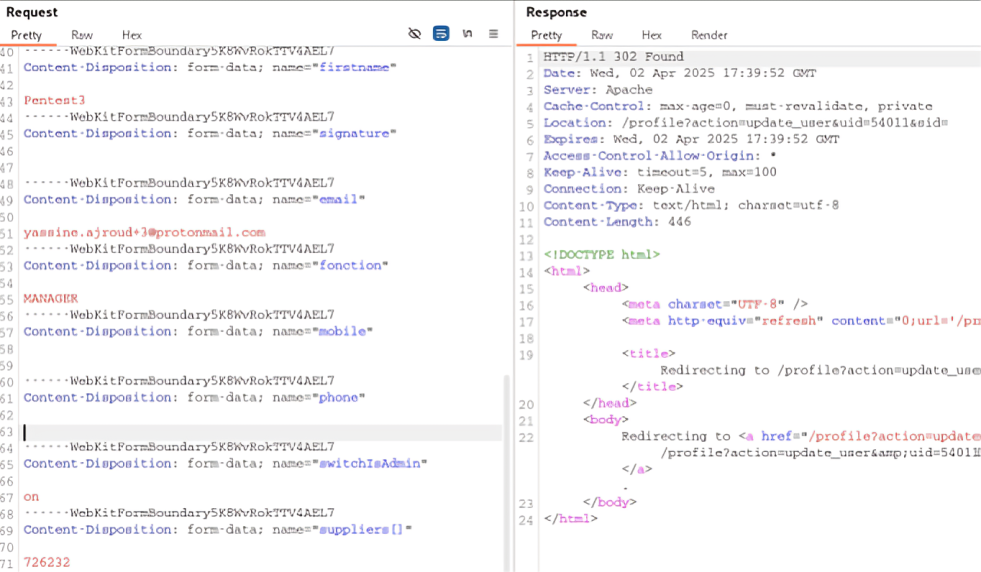
This type of scenario is consistent with the well-known risk categories surrounding APIs: broken access controls, insufficient authentication, imperfect input validation, weak token management and excessive response exposure. An API doesn’t protect the IS just because it talks in JSON. It only protects it if each request is truly controlled.
Once the first step has been taken, the impact can include :
- reading or exfiltration of business data ;
- object or record modification ;
- access to reserved functions ;
- bounce to backends or internal processing ;
- persistence via overly permissive tokens or integrations.
This is why a cybersecurity audit, particularly in Toulouse, focusing on APIs is so valuable: it addresses a central point of modern IS exposure.
How to protect yourself against an API compromise
API risk reduction is based on a few simple principles that must be applied everywhere and consistently:
- control server-side authorizations on each call ;
- reduce OAuth scopes to the strict minimum;
- limit the life and range of tokens ;
- strictly validate server-side inputs ;
- implement rate limiting on sensitive roads;
- log critical calls and anomalies ;
- clearly segment front, API and backend ;
- test APIs after each major change.
Technical risk reduction chart
| Observed weakness | Recommended measurement | Safety impact |
|---|---|---|
| Mauais access control object | Strict server-side authorization | Reduced risk of data leakage |
| OAuth scopes too wide | Less privilege + scopes review | Reducing functional abuse |
| Token too long-lasting | Rotation + short service life | Reducing persistence |
| Exposed secondary roads | Inventory + filtering + deletion | Reduced attack surface |
| Insufficient housing | Logging of sensitive calls | Improved detection |
A very good external source recommended in this article: OWASP API Security
Why carry out a pentest with Hackmosphere
A pentest is only of value if it demonstrates what an attacker can actually do, and helps to correct what exposes the organization. This is exactly the approach advocated by Hackmosphere on its pentest services: testing critical routes, access controls, authentication flows and actual dependencies between services.
In an API context, this approach makes it possible to :
- identify the endpoints that are really exposed ;
- check the robustness of authentication and scopes ;
- measure the impact of a weakness on business data ;
- prioritize corrections according to the real risk to the business.
For an organization based in Toulouse, this means we can check whether APIs are supporting digital transformation without becoming the fastest route to data compromise.
FAQ
In Toulouse, can a pentest test the security of an API even if it’s not public?
Yes, an internal or partner API can expose sensitive data, functions or privileges, even if it is not open to all Internet users. Its level of exposure does not eliminate the risk.
Why do misconfigured JWT or OAuth tokens represent a real danger?
Because a token that’s too permissive, too long-lasting or poorly controlled can enable an attacker to call functions he shouldn’t be able to reach, and maintain access for longer than intended.
What’s the difference between a conventional application security audit and a targeted API pentest in Toulouse?
A targeted API pentest focuses on routes, authorization, tokens, exposed objects, OAuth flows and backend behaviors. It complements web auditing by addressing machine-to-machine exchange logic.
Conclusion
In Toulouse, API security should not be treated as a purely application-related issue. As soon as a route provides access to critical data, processing or integration, it becomes a strategic entry point. A well-conducted pentest in Toulouse enables us to verify this reality, prioritize remediations and ensure that APIs support the business without becoming a structural flaw in the IS.